Lux L1s
Explore the multi-chain architecture of Lux ecosystem.
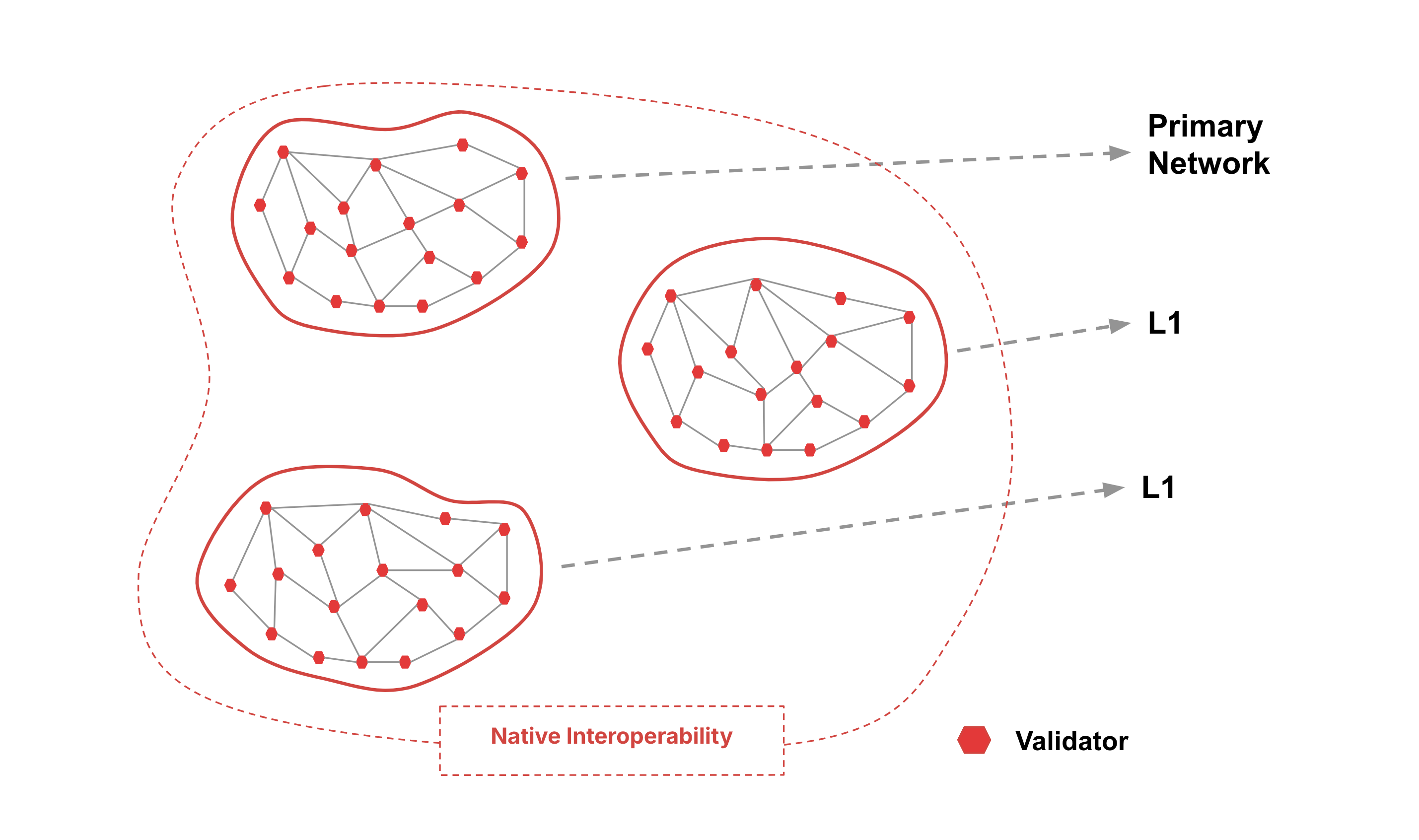
An Lux L1 is a sovereign network which defines its own rules regarding its membership and token economics. It is composed of a dynamic subset of Lux validators working together to achieve consensus on the state of one or more blockchains. Each blockchain is validated by exactly one Lux L1, while an Lux L1 can validate many blockchains.
Lux's Primary Network is a special Lux L1 running three blockchains:
- The Platform Chain (Platform-Chain)
- The Contract Chain (LUExchange-Chain)
- The Exchange Chain (Exchange-Chain)
Note
Every validator of an Lux L1 must sync the Platform-Chain of the Primary Network for interoperability.
Node operators that validate an Lux L1 with multiple chains do not need to run multiple machines for validation. For example, the Primary Network is an Lux L1 with three coexisting chains, all of which can be validated by a single node, or a single machine.
Advantages
Independent Networks
- Lux L1s use virtual machines to specify their own execution logic, determine their own fee regime, maintain their own state, facilitate their own networking, and provide their own security.
- Each Lux L1's performance is isolated from other Lux L1s in the ecosystem, so increased usage on one Lux L1 won't affect another.
- Lux L1s can have their own token economics with their own native tokens, fee markets, and incentives determined by the Lux L1 deployer.
- One Lux L1 can host multiple blockchains with customized virtual machines.
Native Interoperability
Lux Warp Messaging enables native cross-Lux L1 communication and allows Virtual Machine (VM) developers to implement arbitrary communication protocols between any two Lux L1s.
Accommodate App-Specific Requirements
Different blockchain-based applications may require validators to have certain properties such as large amounts of RAM or CPU power.
an Lux L1 could require that validators meet certain hardware requirements so that the application doesn't suffer from low performance due to slow validators.
Launch Networks Designed With Compliance
Lux's L1 architecture makes regulatory compliance manageable. As mentioned above, an Lux L1 may require validators to meet a set of requirements.
Some examples of requirements the creators of an Lux L1 may choose include:
- Validators must be located in a given country.
- Validators must pass KYC/AML checks.
- Validators must hold a certain license.
Control Privacy of On-Chain Data
Lux L1s are ideal for organizations interested in keeping their information private.
Institutions conscious of their stakeholders' privacy can create a private Lux L1 where the contents of the blockchains would be visible only to a set of pre-approved validators.
Define this at creation with a single parameter.
Validator Sovereignty
In a heterogeneous network of blockchains, some validators will not want to validate certain blockchains because they simply have no interest in those blockchains.
The Lux L1 model enables validators to concern themselves only with blockchain networks they choose to participate in. This greatly reduces the computational burden on validators.
Why Build Your Own Lux L1
There are many advantages to running your own Lux L1. If you find one or more of these a good match for your project then an Lux L1 might be a good solution for you.
We Want Our Own Gas Token
LUExchange-Chain is an Ethereum Virtual Machine (EVM) chain; it requires the gas fees to be paid in its native token. That is, the application may create its own utility tokens (ERC-20) on the LUExchange-Chain, but the gas must be paid in LUX. In the meantime, Subnet-EVM effectively creates an application-specific EVM-chain with full control over native(gas) coins. The operator can pre-allocate the native tokens in the chain genesis, and mint more using the Subnet-EVM precompile contract. And these fees can be either burned (as LUX burns in LUExchange-Chain) or configured to be sent to an address which can be a smart contract.
Note that the Lux L1 gas token is specific to the application in the chain, thus unknown to the external parties. Moving assets to other chains requires trusted bridge contracts (or upcoming cross Lux L1 communication feature).
We Want Higher Throughput
The primary goal of the gas limit on LUExchange-Chain is to restrict the block size and therefore prevent network saturation. If a block can be arbitrarily large, it takes longer to propagate, potentially degrading the network performance. The LUExchange-Chain gas limit acts as a deterrent against any system abuse but can be quite limiting for high throughput applications. Unlike LUExchange-Chain, Lux L1 can be single-tenant, dedicated to the specific application, and thus host its own set of validators with higher bandwidth requirements, which allows for a higher gas limit thus higher transaction throughput. Plus, Subnet-EVM supports fee configuration upgrades that can be adaptive to the surge in application traffic.
Lux L1 workloads are isolated from the Primary Network; which means, the noisy neighbor effect of one workload (for example NFT mint on LUExchange-Chain) cannot destabilize the Lux L1 or surge its gas price. This failure isolation model in the Lux L1 can provide higher application reliability.
We Want Strict Access Control
The LUExchange-Chain is open and permissionless where anyone can deploy and interact with contracts. However, for regulatory reasons, some applications may need a consistent access control mechanism for all on-chain transactions. With Subnet-EVM, an application can require that "only authorized users may deploy contracts or make transactions." Allow-lists are only updated by the administrators, and the allow list itself is implemented within the precompile contract, thus more transparent and auditable for compliance matters.
We Need EVM Customization
If your project is deployed on the LUExchange-Chain then your execution environment is dictated by the setup of the LUExchange-Chain. Changing any of the execution parameters means that the configuration of the LUExchange-Chain would need to change, and that is expensive, complex and difficult to change. So if your project needs some other capabilities, different execution parameters or precompiles that LUExchange-Chain does not provide, then Lux L1s are a solution you need. You can configure the EVM in an Lux L1 to run however you want, adding precompiles, and setting runtime parameters to whatever your project needs.
We Need Custom Validator Management
With the Etna upgrade, L1s can implement their own validator management logic through a ValidatorManager smart contract. This gives you complete control over your validator set, allowing you to define custom staking rules, implement permissionless proof-of-stake with your own token, or create permissioned proof-of-authority networks. The validator management can be handled directly through smart contracts, giving you programmatic control over validator selection and rewards distribution.
We Want to Build a Sovereign Network
L1s on Lux are truly sovereign networks that operate independently without relying on other systems. You have complete control over your network's consensus mechanisms, transaction processing, and security protocols. This independence allows you to scale horizontally without dependencies on other networks while maintaining full control over your network parameters and upgrades. This sovereignty is particularly important for projects that need complete autonomy over their blockchain's operation and evolution.
When to Choose an Lux L1
Here we presented some considerations in favor of running your own Lux L1 vs. deploying on the LUExchange-Chain.
If an application has relatively low transaction rate and no special circumstances that would make the LUExchange-Chain a non-starter, you can begin with LUExchange-Chain deployment to leverage existing technical infrastructure, and later expand to an Lux L1. That way you can focus on working on the core of your project and once you have a solid product/market fit and have gained enough traction that the LUExchange-Chain is constricting you, plan a move to your own Lux L1.
Of course, we're happy to talk to you about your architecture and help you choose the best path forward. Feel free to reach out to us on Discord or other community channels we run.
Develop Your Own Lux L1
Lux L1s on Lux are deployed by default with Subnet-EVM, a fork of go-ethereum. It implements the Ethereum Virtual Machine and supports Solidity smart contracts as well as most other Ethereum client functionality.
To get started, check out our L1 Toolbox or the tutorials in the Lux CLI section.
Is this guide helpful?